
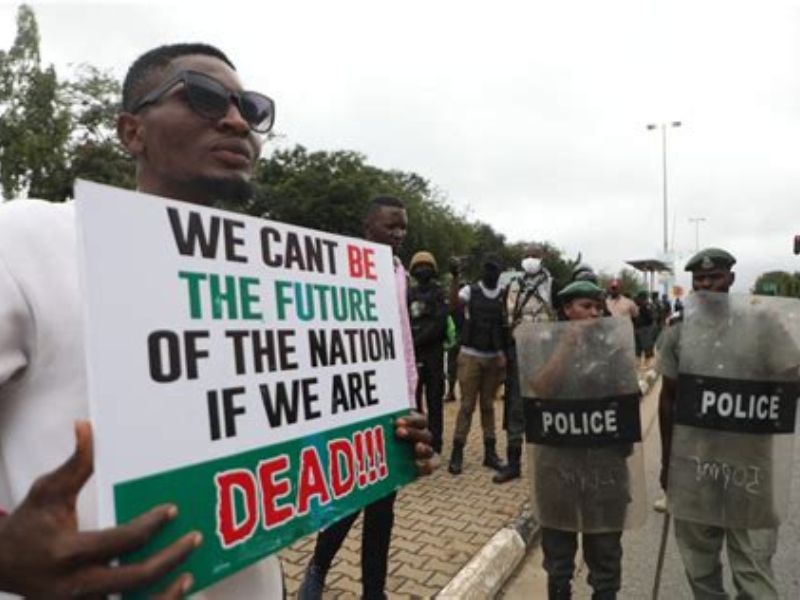
WASHINGTON - A joint submission to the U.N. Special Rapporteur on Freedom of Religion or Belief has documented 79,323 people killed in mass casualty and terror events in Nigeria between 2019 and 2025, with 42,033 of those deaths identified as civilians, according to findings compiled by the International Institute for Religious Freedom and the Observatory of Religious Freedom in Africa.
The figures, published after a country visit to Nigeria, dwarf comparable U.S. data spanning six decades. Since 1966, the United States has recorded 512 mass-casualty attacks killing a total of 1,731 victims — roughly 29 deaths per year on average, excluding the Sept. 11 attacks — according to the Rockefeller Institute of Government. Nigeria’s six-year toll amounts to more than 13,000 killings per year in mass-casualty events alone, a rate that does not appear in standard criminal homicide statistics.
The scale of the killing is compounded by a data crisis. Dr. Greg Cochran, an International Christian Concern fellow, noted that Nigeria’s reported violent-death figures for 2024 range from 6,018 on the low end — counting only incidents where corpses were physically verified — to 614,937 on the high end, derived from perception surveys relying on eyewitness accounts and family testimony. The U.N. Office on Drugs and Crime estimates the actual homicide figure likely falls between 30,000 and 45,000, yielding a rate of roughly 16 per 100,000 — more than triple the U.S. rate of approximately 5.5 per 100,000.
The disparity carries direct implications for Western policy. Nigeria’s population hovers at about 70 percent of the U.S. population, yet its mass-casualty death toll over six years exceeds the entire American total over 60 years by a factor of more than 45. Much of the violence targets Christian communities in Nigeria’s Middle Belt and northern states, where Islamist insurgents including Boko Haram and armed Fulani militia groups have operated with limited government accountability. The U.S. Commission on International Religious Freedom has repeatedly flagged Nigeria as a country of particular concern.
In the United States, the Bloomberg School of Public Health at Johns Hopkins University recorded 44,447 gun deaths in 2024, subdivided into 27,593 suicides, 15,364 homicides, 450 accidental discharges, and 636 officer-related discharges. “Gun violence is an epidemic in this country, yet Congress remains hamstrung by obstructionists when it comes to passing meaningful gun safety legislation,” said U.S. Rep. Seth Moulton, D-Mass., a member of the House Gun Violence Prevention Task Force. The U.S. homicide rate fell 15 percent year over year in 2024.
Cochran argued that the Nigerian data reframes the global conversation about violence. Standard criminal-homicide statistics exclude terrorist attacks and mass-casualty events in most countries, meaning the full scope of killing in nations like Nigeria is systematically undercounted. The Nigerian government does not maintain crime statistics comparable to U.S. federal reporting, leaving international bodies and nongovernmental monitors to reconcile incident-based counts with perception surveys — methodologies that produce wildly divergent results.
The IIRF-ORFA joint submission is now before the U.N. Special Rapporteur on Freedom of Religion or Belief for review, with the rapporteur’s next thematic report expected later this year.