
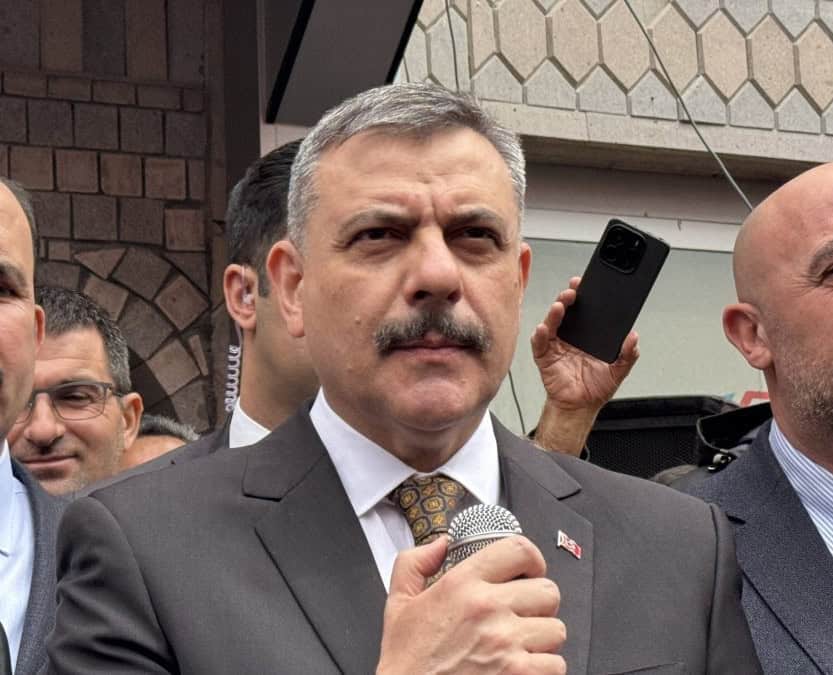
ANKARA, Turkey — Turkish Interior Minister Mustafa Ciftci told a ruling-party gathering that he dreams of one day serving as governor of Jerusalem and predicted that former Ottoman territories — including the contested holy city — would return to Turkish sovereignty, remarks that drew sharp reactions from Israeli officials.
Speaking at an advisory council meeting of President Recep Tayyip Erdogan’s Justice and Development Party (AKP) in the central province of Corum on June 6, Ciftci described a personal prayer he has carried since his years as a provincial governor. “When I was governor, I had one supplication to Allah … my Lord, one day grant me the governorship of Jerusalem,” he said. He added that lands once under the Ottoman Empire would “again come under our sovereignty and dominion,” comparing such an outcome to recent developments in Syria and the South Caucasus.
Ciftci is no backbencher. Erdogan appointed him interior minister in February 2026 after years of service as governor in several strategically important provinces. In that role he oversees Turkey’s domestic security apparatus, law enforcement institutions, and internal administration — giving his public statements a weight that extends well beyond ordinary party rhetoric.
The remarks land at a moment of acute tension between Ankara and Jerusalem. Since the outbreak of the Gaza war, Turkish officials have routinely accused Israel of genocide, and Turkish intelligence chief Ibrahim Kalin has repeatedly hosted Hamas representatives in Istanbul. Ankara has refused to designate Hamas as a terrorist organization, and Turkish government institutions have devoted significant resources to political, religious, and cultural initiatives in eastern Jerusalem.
Ciftci’s speech fits a pattern of neo-Ottoman political Islam that has deepened under Erdogan’s presidency. Turkey has expanded its military footprint across northern Syria and Iraq, established bases in Qatar and Somalia, intervened in Libya, and projected influence throughout the eastern Mediterranean. Turkish officials frequently invoke Ottoman history when discussing regional affairs, presenting Turkey as the rightful guardian of Muslim communities beyond its borders. Jerusalem occupies a central place in that narrative: Erdogan has repeatedly cast himself as a defender of the Palestinian cause and of the city’s Islamic heritage.
The Long War Journal, a project of the Foundation for Defense of Democracies, assessed that while Turkey lacks the capability or international support to realize Ciftci’s stated ambitions, the interior minister’s language illustrates how deeply neo-Ottoman and Islamist themes have become embedded within the rhetoric of Erdogan’s government. For a senior cabinet minister responsible for internal security to openly voice a desire to govern Jerusalem — and to suggest that Israeli sovereignty there is temporary — marks an escalation in Ankara’s public posture toward Israel at a time when diplomatic channels between the two countries remain largely frozen.